

Bengal is a hidden treasure of fungal diversity. Though often overlooked, countless species of mushrooms, molds, lichens, and wild fungi thrive across its 88,752 sq km of varied landscapes. I am trying to introduce the funga of Bengal in a single guide from the naturalist view, not from the eye of biota-expert. For this, Some unintended errors may occur. Pointless to say, pics used in this site are all original and Shot by me. The information are gathered here from the personal notes, collected books and from different websites.
What is the historical meaning of the term funga?
The term “funga” comes from the Latin word “fungus” (meaning mushroom).
🍄 Origin of the Term Funga:
- The term “funga” is a modern scientific creation derived from the Latin word “fungus.”
- It is derived from the Latin word “fungus,” which means mushroom.
- Unlike flora and fauna, which have roots in ancient Roman mythology, the term “funga”was developed by scientists and mycologists to recognize the fungal kingdom as a distinct and vital component of biodiversity.
- Historically, fungi were grouped with plants due to their similar appearance and stationary growth habits, but modern biology has shown that they differ significantly in their are genetically, structurally, and functionally distinct from plants.
- They do not photosynthesize like plants and instead absorb nutrients from decaying organic matter. Many also form complex symbiotic associations with both plants and animals, playing essential roles in ecosystems.
- The term funga was introduced by mycologists to represent fungal biodiversity equally alongside flora and fauna, specially in ecological research and conservation contexts.
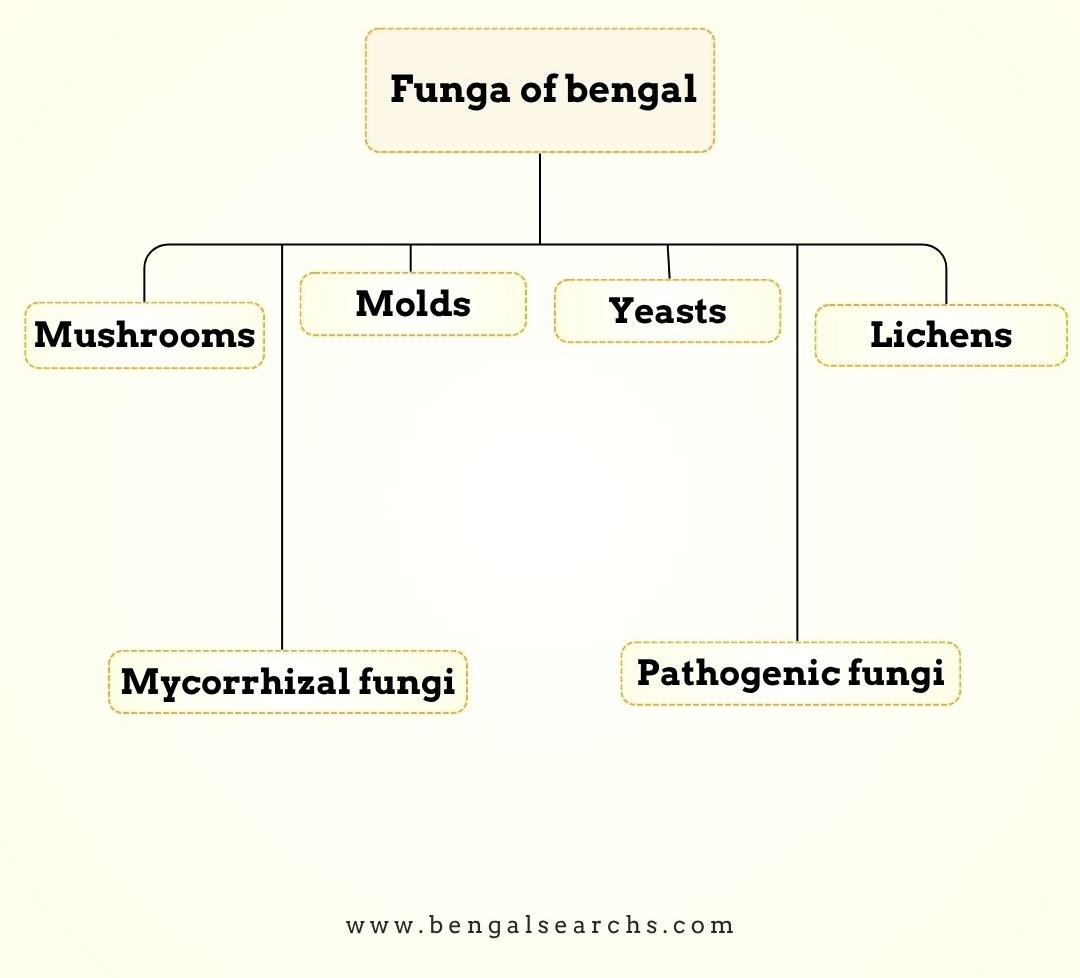
- It collectively refers to all fungal life in a given region— including mushrooms, molds, yeasts, lichens, and fungi that live in association with plant roots, like mycorrhizae.
- As awareness of fungal diversity grows, funga is increasingly recognized as the “third kingdom” of life on Earth, alongside flora and fauna in ecosystem studies.
- It is also used to describe scientific works or books that document and classify fungi in a given area — for example, a funga of Bengal would catalog all known fungal species found in Bengal.
What is The funga of Bengal ?
The Funga of Bengal refers to the fungi of a particular region, habitat or geological period.
🍄 Types of bengal Funga (Fungal Life of bengal) :-
Mushrooms
- Shojna, Moringa oleifera
- Neem, Azadirachta indica
- Dumur, Ficus hispida
- Bel or Wood apple, Eegle marmelos
- Kodbel or Elephant wood apple, Feronia limonia
- Taal, Borassus flabellifer
- Khejur or Indian date, Phoenix sylvestris
- Shupari or Betel nut, Areca catechu
- Tetul, Tamarindus indica
- Kodom, Neolamarckia cadamba
- Bot, Ficus benghalensis
- Krishnachura or Royal poinciana, Delonix regia
- Mehedi, Henna, Lawsonia inermi
- Karipata or Curry tree, Murraya koenigii
- Keora or Mangrove apple, Sonneratia apetala
- Babla or Babul, Vachellia nilotica
- Batul or Swamp willow, Shirakiopsis indica
- Kolkey or Yellow oleander, Cascabela thevetia
- Bokul or Medlar, Mimusops elengi
- Aam or Mango, Mangifera indica
- Jaam or Black plum, Syzygium cumini
- Kathal or Jack fruit, Artocarpus heterophyllus
- Amra, Hog plum, Spondias pinnata
- Jolpai or Ceylon olive, Elaeocarpus serratus, Elaeocarpaceae
- Chatim, Devil’s tree, Alstonia scholaris
- Shiuly or Night jasmine, Nyctanthes arbor-tristis
- Kamranga, Averrhoa carambola
- Dalim, Punica granatum
- Ashok, Saraca asoca
- Bokul or Medlar, Mimusops elengi
- Daruchini or True cinnamon tree, Cinnamomum verum
- Jarul, Lagerstroemia speciosa
- Barun, Crataeva nurvala
- Shonalu, Cassia fistula
- Konok-chapa, Ochna squa
- Shimul, Bombax ceiba
- Bilombi, Averrhoa bilimbi
- Ghora-neem, Melia azedarach
- Shirish, Albizia lebbeck
- Hijol, Barringtonia acutangula
- Kajubadam or Cashew nut, Anacardium occidentale
- Shegun or Teak, Tectona grandis
- Konokchura, Peltophorum pterocarpum
- Bottlebrush or Lemon bottlebrush, Melaleuca citrina
- Shinduri bij or Achiote, Bixa orellana
- Champa, Champaca, Magnolia champaca
- Jilapi babul, Khoia babla, Pithecellobium dulce
- Ashoth, Ficus religiosa
- Akorkonto or Sage-leaved alangium, Alangium salvifolium
- Udal or Elephant rope tree, Sterculia villosa
- Polash or Flame of the forest, Butea monosperma
- Joggodumur or Jagdumur, Ficus racemosa
- Gaab or Indian persimmon, Diospyros peregrina
- Tomal, Diospyros cordifolia
- Kaath-badam, Terminalia catappa
- Telshur, Hopea odorata
- Arjun, Terminalia arjuna
- Mahua, Madhuca, Madhuca longifolia
- Mahogany, Swietenia mahagoni
- Debdaru, Polyalthia longifolia
- Rose cactus, Pereskia bleo
- Chalta, Elephant apple, Dillenia indica
- Horitoki, Chebulic myrobalan, Terminalia chebula
- Furush, Crape myrtle, lagerstroemia indica
- Toon, Toona ciliata
- Bon shupari, Caryota urens
- Gogon shirish, Albizia richardiana
- Pitalu or Laddu, Trewia nudiflora
- Kukurchita, Litsea glutinosa
- Ashphol or Longan tree, Dimocarpus longan
- Koronga or Pongam tree, Pongamia pinnata
- Shorgo-poddo or Heaven lotus, Gustavia augusta
- Nagesshor or Ceylon ironwood, Mesua ferrea
- Padauk or Malay padauk, Pterocarpus indicus
- Horina or Boro horina, Lepisanthes rubiginosa
- Shet-shimul or Kapok, Ceiba pentandra
- Shal or Sal, Shorea robusta
- Amloki or Amla, Phyllanthus emblica
- Gamari or White teak, Gmelina arborea
- Jambura or Pomelo, Citrus grandis
- Deua or Monkey jack, Artocarpus lacucha
- Parul or Fragrant padri Tree, Stereospermum chelonoides
- Orun or Scarlet cordia, Cordia sebestena
- Kajuput or Weeping paperbark, Melaleuca leucadendra
- Cha or Tea, Camellia sinensis
- Sultanchapa, Punnag, Calophyllum inophyllum
- Pakur, Ficus infectoria
- Palan, Scarlet wrightia, Wrightia coccinea
- Kurchi or Girimollika, Holarrhena antidysenterica
- Gewa or Blind your eye mangrove, Excoecaria agallocha
- Lotkon or Burmese grape, Baccaurea ramiflora
- Koinari, Golden gardenia, Gardenia coronaria
- Shet-chondon or Sandalwood, Santalum album
- Asor-gota, Microcos paniculata
- Bain or Indian mangrove, Avicennia officinalis
- Bajna or Cape yellowwood, Zanthoxylum rhets
- Chaulmugra or Dalmugri, Hydnocarpus kurzii
- Porosh-pipul or Tulip tree, Thespesia populnea
- Buddho narikel or Buddha coconut, Pterygota alata
- Rubber bot or Indian rubber, Ficus elastica
- Kamela or Monkey-face tree, Mallotus philippensis
- Ritha or Soapberry, Sapindus saponaria
- Jongli badam or Bastard poon tree, Sterculia foetida
- Ramjani or Wild berry, Maesa indica
- Jhika or Indian ash tree, Lannea coromandelica
- Kolkey or Yellow oleander, Cascabela thevetia
- Jibon or Indian nettle tree, Trema orientalis
- Folsha or Falsa, Grewia asiatica
- Jongoilla shak or Dogal tree, Sarcochlamys pulcherrima
- Choto betmara or Choto birmala, Calliandra umbrosa
- Paniaphul or Hopbush, Dodonaea viscosa
- Orboroi or Star gooseberry, Phyllanthus acidus
- Lohakath or Burma Ironwood, Xylia xylocarpa
- Dulichapa or Wild magnolia, Magnolia pterocarpa
- Shilbhadi or Grey downy balsam, Garuga pinnata
- Kushum or Ceylon oak, Schleichera oleosa
- Lal shonail or Pink shower, Cassia javanica
- Naglingom or Canon ball tree, Couroupita guianensis
- Kanchon or Orchid tree, Bauhinia variegata
- Raj oshok or Pride of Burma, Amherstia nobilis
- Chapalish or Chaplash, Artocarpus chama
- Onjon or Iron-wood tree, Memecylon edule
- Gorjon or Gurjan, Dipterocarpus turbinatus
- Maila aam or Burmese Plum, Bouea oppositifolia
- Roktokombol or Circassian Tree, Adenanthera pavonina
- Agor or Lign aloes, Aquilaria agallocha
- Bohera or Belleric myrobalan, Terminalia bellirica
- Bandorhola or Ramdalu, Duabanga grandiflora
- Kanaidinga or Indian trumpet flower, Oroxylum indicum
- Kuchila or Nux-vomica, Strychnos nux-vomica
- Boloch or Bolosh, Balakata baccata
- Jamalgota or Gum plant, Jatropha curcas
Molds
- Bhat, Ghetu, Clerodendrum viscosum
- Hatishura, Indian heliotrope, Heliotropium indicum
- Dhutra, Dhatura, Datura metel
- Kalmegh or Green chirayta, Andrographis paniculata
- Kulekhara or Talmakhna, Hygrophila auriculata
- Shorpogondha or Black snakeroot, Rauvolfia serpentina
- Lojjaboti, Touch me not, Mimosa pudica
- Durba-ghash or Bermuda grass, Cynodon dactylon
- Til, Sesamum indicum
- Holud hurhuri, Cleome viscosa
- Choto hurhuri, Cleome rutidosperma
- Bokkon, Fog fruit, Phyla nodiflora
- Nunia, Common purslane, Portulaca oleracea
- Bishkatali, Pale persicary, Persicaria lapathifolia
- Amrul or Indian Sorrel, Oxalis corniculata
- Apang or Prickly chafflower, Achyranthes aspera
- Lungichor or Running Mountain Grass, Oplismenus compositus
- Ashwagandha or Winter cherry, Withania somnifera
- Kanta notey or Prickly amaranth, Amaranthus spinosus
- Tridhara or Coatbuttons, Tridax procumbens
- Bon-moricha, Pigeon berry, Rivina humilis
- Nilkanthi or Blue Snakeweed, Stachytarpheta urticifolia
- Kachchhara or Ceylon hydrolea, Hydrolea zeylanica
- Braziler Paat or Brazil jute, Malachra capitata
- Chakunda or Sickle senna, Senna tora
- Boro kolkashundey or Western senna, Senna occidentalis
- Gima-shak or Pot-biroot, Glinus oppositifolius
- Muktajhuri, Indian acalypha, Acalypha indica
- Kaash, Saccharum spontaneum
- Danda-kolosh, Leucas indica
- Potpoti, Ruellia tuberosa
- Bon-tepari, Physalis angulata
- Kakmachi, Solanum nigrum
- Katabegun or Jongli tomato, Sticky nightshade, Solanum sisymbriifolium
- Punarnava, Boerhavia diffusa
- Sotthi, zedoary, Curcuma zedoaria
- Dhaira, Loranthus globosus
- Kanchira, Bengal dayflower, Commelina benghalensis
- Bon tamak or Wild tobacco, Nicotiana plumbaginifolia
- Keteli or Creeping thistle, Cricus arvensis
- Roktodron or Red verticilla, Leonurus sibiricus
- Allugash, Mantisia radicalis
- Relandi or Cinderella weed, Synedrella nodiflora
- Mushok-dana or Musk-mallow, Abelmoschus moschatus
- Chinigura or Sweet broomweed, Scoparia dulcis
- Boro cahdor or Boro chondrika, Rauvolfia tetraphylla
- Ghaghra or Bon okra, Xanthium strumarium
- Shachi or Sessile joyweed, Alternanthera sessilis
- Kalokeshi or False daisy, Eclipta prostrata
Yeasts
- Bhat, Ghetu, Clerodendrum viscosum
- Koromcha, Carissa carandas
- Mehedi, Henna, Lawsonia inermi
- Kamini, Murraya paniculata
- Dholkolmi, Ipomoea carnea
- Buno joba or Jongli ghagra, Urena lobata
- Akondo, Calotropis gigantea
- Konok-chapa, Ochna squarrosa
- Kathali-chapa, Artabotrys hexapetalus
- Olokanonda, Allamanda, Allamanda catharica
- Dalim, Punica granatum
- Daruhoridra or Narrow-leaf morinda, Morinda angustifiolia
- Lutki, Datranga, Melastoma malabathricum
- Stholopoddo, Sthol-padma, Hibiscus mutabilis
- Radhachura, Caesalpinia pulcherrima
- Verenda, Ricinus communis
- Jol nishinda, Vitex trifolia
- Furush, Crape myrtle, Lagerstroemia indica
- Jhumko-joba, Hibiscus schizopetalus
- Rose cactus, Pereskia bleo
- Ulotkombol, Cotton Abroma, Abroma augustum
- Dholshomudro, Leea macrophylla
- Kew or Crepe ginger, Cheilocostus speciosus
- Chitki, Phyllanthus reticulatus
- Lal verenda or Bellyache bush, Jatropha gossypifolia
Lichens
- Kaakrol, Momordica dioica
- Telakucha, Coccinia grandis
- Oporajita, Butterfly pea, Clitoria ternatea
- Nil bonolota, Bengal trumpet, Thunbergia grandiflora
- Shornolota or Dodder, Cruscuta reflexa
- Makal or Mahakal, Trichosanthes tricuspidata
- Madhobi-lota or Madhabi, Hiptage benghalensis
- Pipul or Long piper, Piper longum
- Maloti or Malati, Aganosma dichotoma
- Asam lota, Rabon lota, Mikania micrantha
- Monkey’s brush, Combretum rotundifolium
- Ashari-lota or Asaria, Capparis zeylanica
- Alkushi or Cowitch, Mucana pruriens
- Gondhovadulia or Skunkvine, Paederia foetida
- Onguli lota or Tiger’s footprint, Ipomoea pes-tigridis
- Ulot-chondal, Gloriosa superba
- Guloncho, Guroncho, Tinospora cordifolia
- Onontolota, antogonon Leptopus
- Roshundi-lota or Garlic vine, Manosa alliacea
- Aknadi or Snake vine, Stephania japonica
- Shotomuli or Shatawari, Asparagus racemosus
- Har-jora lota, Cissus quadrangularis
- Blue morning glory, Ipomoea nil
- Modhunasini or Gurmar, Gymnema sylvestre
- Isshormul or Indian Birthwort, Aristolochia indica
- Amla lota, fox grape, Cayratia trifolia
- Hongsho lota, Calico flower, Aristolochia littoralis
- Kaladana or Ivy Woodrose, Merremia hederacea
- Khudey ghonti or Littlebell, Ipomoea triloba
- Batilota or Climbing aroid, Pothos scandens
- Lota futki, Balloon plant, Cardiospermum halicacabum
- Modu-monjori, Rangoon creeper, Combretum indicum
- Roti or Jequirity Abrus precatorius
- Bhui dumur, Ficus heterophylla var. assamica
- Hapormali or Bread flower, Vallaris solanacea
- Chotro-pushpo or lady’s umbrella, Holmskioldia sanguinea
- Amkurchi or Kali lota, Derris scandens
- Congea or Wooly congea, Congea tomentosa
- Trumpet vine, Campsis grandiflora
- Easter Lily Vine, Beaumontia grandiflora
Pathogenic fungi
- Kochuripana, Water hyacinth, Eichhornia crassipes
- Shaluk or Blue water lily, Nymphaea nouchali
- Shapla, Water Lily, Nymphaea pubescens
- Kochu or Taro, Colocasia esculenta
- Padma, Lotus, Nelumbo nucifera
- Kopi-pana or Kariba weed, Salvinia molesta
- Kolmi-lota, Ipomoea aquatica
- Boronukha, Monochoria hastata
- Rokto-komol, Red water lily, nymphaea rubra
- Keshordam, Ludwigia adscendens
- Chandmala or Water snowflake, Nymphoides indica
- Dhonche or Prickly sesban, Sesbania bispinosa
- Jhajhidam or Bladderwort, Utricularia flexuosant
- Chondromala or Crested floating-heart, Nymphoides cristatum
- Maloncho or Alligator weed, Alternanthera philoxeroides
- Shitolpati or Murta, Schumannianthus dichotomus
- Panikola or Duck lettuce, Ottelia alismoides
- Nolkhagra or Giant cane, Arundo donax
- Jhanjhi or Water thyme, Hydrilla verticillata
- Hogla or Southern cattail, Typha domingensis
- Binna-ghash or Vetiver grass, Chrysopogon zizanioides
- Topapana or Water lettuce, Pistia stratiotes
- Shushni or Four leaf clover, Marsilea quadrifolia
- Shachi or Sessile joyweed, Alternanthera sessilis
- Khudi pana or Minute duckweed, Lemna perpusilla
- Tilok pana or floating fern, Salvinia natans
- Jolbahar or Water sprite, Ceratopteris thalictroides
- Thankuni or Asiatic pennywort, Centella asiatica
- Holdey pana or Sawah Lettuce, Limnocharis flava
- Pani chech or Purple spikerush, Eleocharis atropurpurea
Mycorrhizal fungi
Lorem ipsum dolor sit amet, consectetur adipiscing elit. Ut elit tellus, luctus nec ullamcorper mattis, pulvinar dapibus leo.
Discover the Unique Habitats of Bengal's Fungi
Bengal’s diverse ecosystems, from lush forests to wetlands and urban spaces, offer a variety of niches for fungi. Each area uniquely contributes to the rich diversity of fungi. From the shadowy undergrowth of the Sundarbans to the cool forests of the Himalayan foothills, each environment harbors distinct fungal species. Here, we explore these diverse landscapes and the vital relationships fungi maintain with plants, animals, and the ecosystem. This journey invites you to appreciate the crucial role fungi play in sustaining biodiversity and ecological health.
Key Habitats to Explore
1. Tropical Rainforests: Rich in organic matter, these dense woods provide an ideal habitat for mushrooms and medicinal fungi, unveiling countless new species each rainy season.
2. Wetlands: The unique moisture levels nurture specific mold species and mycorrhizal fungi, vital for plant health.
3. Grasslands: Often overlooked, these vast areas host nutrient-cycling fungi that support the ecosystem.
4. Urban Areas: As nature adapts, urban spaces reveal hidden fungal species, offering insights into the resilience of fungi.
Fungi's Ecological Role
Discover a variety of fungal species through images that highlight their ecological importance in Bengal’s rich habitats. Each photo showcases the unique role fungi play in their environments.